


The promise of TPU tubes sounded like music to my ears: light weight, high puncture protection and easy rolling - all without the hassle and mess of tubeless systems. I felt like I was in biker heaven, because this was everything I had always wanted for my trail bike. I'm actually an absolute tubeless advocate, because I want my bike to get me from one trail to the next efficiently. I also appreciate low air pressure for better damping and grip, but I don't want to flinch at every little stone for fear of the next puncture.
Really annoying - even though the assembly is easy thanks to modern high-flow valves However, I found the setup and servicing of tubeless systems to be much simpler today than in the past, thanks to tools such as the Tubeless Conversion Kit from Milkit. Constant questions: Is there still enough sealant in the tyre? Is the milk still liquid or has it dried up? And then there's the mess when you have to retract a tube in the event of a puncture. TPU sounded like the cure for all my problems. But what actually makes TPU inner tubes so special?

The newcomer: What makes TPU so special?
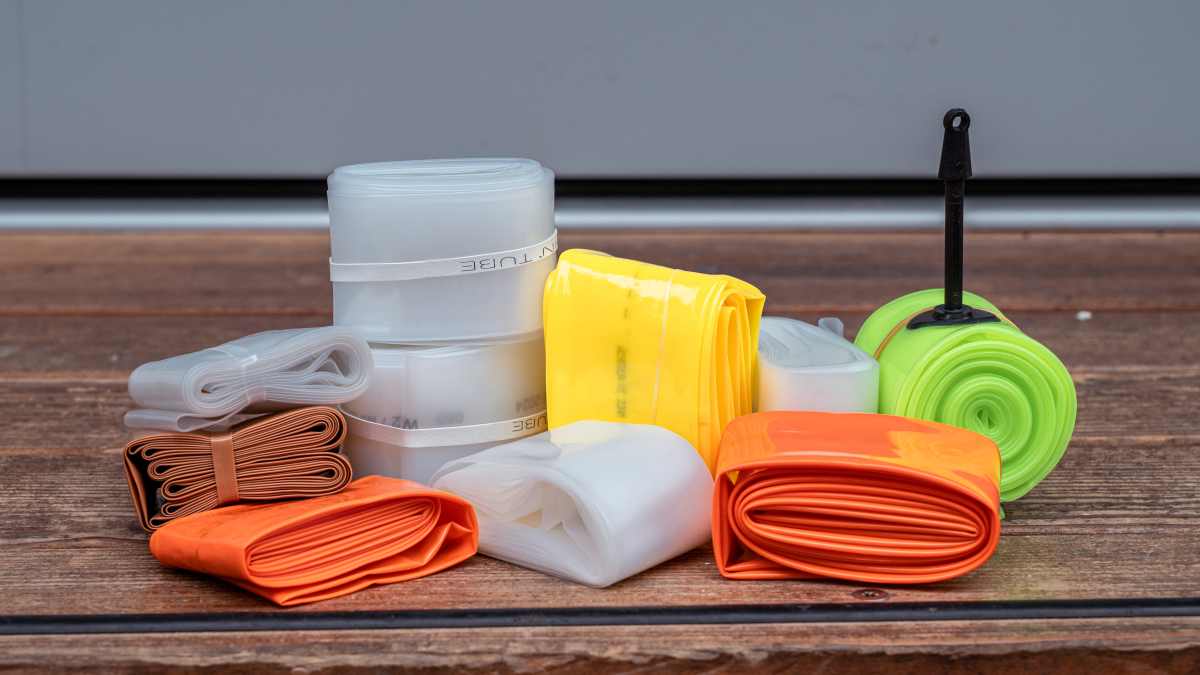
TPU tubes (known from brands such as Aerothan, Tubolito or Revoloop) break with the tradition of black rubber. The material is significantly thinner, lighter and yet surprisingly resistant. While a standard butyl inner tube for mountain bikes is often 150 to 200 grams TPU counterparts often only weigh 40 to 100 grams.
The advantages at a glance:
- Minimal pack size: When rolled up, a TPU inner tube is barely bigger than a bar. This makes it the perfect spare inner tube for your jersey pocket.
- Low rolling resistance: Due to the high flexibility of the material, there is less flex loss in the tyre. Here, high-quality TPU tubes are almost on a par with latex tubes or tubeless systems.
- High puncture resistance: Despite its thinness, TPU is tougher than butyl. It offers greater resistance to sharp objects that try to pierce the casing.

The other side of the coin:
- The price: At 20 to 30 euros each, they cost many times more than a 5-euro butyl hose.
- Sensitivity during assembly: TPU is not forgiving of mistakes. If the inner tube is pinched during insertion or inflated too much without a tyre, it can become permanently deformed or burst.
- Low manufacturing tolerances: The material requires extremely high manufacturing quality. In practice, deviations in the material thickness can lead to sudden air loss.
The comparison: TPU vs. butyl vs. tubeless
To make it easier for you to categorise and choose the best system for you personally, a direct comparison of the three variants will help:
| Butyl hose | TPU hose | Tubeless system | |
| Weight | High | Extremely low | Low (despite milk) |
| Rolling resistance | High | Low | Very low |
| Puncture protection | Base | Good (puncture) | Excellent (self-healing) |
| Price | Very favourable | Expensive | Medium to expensive |
| Maintenance | Minimal | Minimal | High (top up milk) |
| Assembly | Simple | Caution required | Sophisticated |
TPU hoses - just empty promises?
Despite their promising properties, I never really warmed to the new TPU tubes. It started with the assembly. Inflated a little too tightly and the inner tube bulges like a boa constrictor that has just eaten a rabbit. With less air, however, the inner tube is difficult to pull over the rim and you have to be extremely careful when fitting the tyre so as not to crush the inner tube on the rim flange.

Even if the puncture protection in the laboratory is quite high, the TPU inner tubes remain quite vulnerable in practice. Small particles of dirt between the inside of the tyre and the inner tube can wear away the material in a very short time. Pop, and the air is out. In addition, various tyres inexplicably deflated completely. During the ride, everything was still OK, but before the next tour, the bike was hanging flat on the hook in the garage. A hole or a defect in the bonding of the valve stem? It was impossible to tell.
The problem: the material requires extremely high manufacturing quality. Our measurements confirm the high quality of most of the test candidates. However, deviations in the material thickness can lead to sudden air loss in practice - and I have experienced this more than once.
My conclusion on TPU tubes
In theory, TPU tubes seem like the ultimate for tyres. But laboratory values are unfortunately only half the truth. In practice, I was not convinced by the lightweight plastic inner tubes. They are like little divas, bitchy, complicated and the façade crumbles under the thick layer of make-up. In practice, the system is too unreliable for me. I have no use for spontaneous air loss on a tour. As a lightweight spare tube for marathon races or gravel tours, where low weight plays a decisive role, the TPU tubes can be an alternative. But when I get home, at least for me, they go back into the hip bag or storage compartment of my bike.

Stefan Frey
Editor
