Pedemontana Cycle Route FVG3: A cycle tour through the treasures of Friuli


The Ciclovia Pedemontana FVG3 runs 180 kilometres along the Friulian Alpine arc: from the Venetian-influenced Sacile to the Collio wine region to Gorizia - European Capital of Culture 2025 together with Nova Gorica - via Maniago, famous for its cutlery, the UNESCO World Heritage Site of Cividale del Friuli, through four DOC wine regions and accompanied by the culinary delights of Friuli Venezia Giulia.
Renaissance and World Heritage: from Sacile to Maniago
The morning is cool over the canals of Sacile. It is not for nothing that the small town is nicknamed the "Garden of the Serenissima" - the Pedemontana cycle path begins here, where the mighty Republic of Venice once held its summer retreat. Before setting off, it is worth taking a look at the magnificent Ragazzoni Palace with its ornate Renaissance façade or making a detour to the nearby Vistorta winery. The historic estate, whose origins date back to the 16th century, is not only known for its excellent DOC wines, but also for its impressive Venetian-style villa. From Sacile, the cycle path leads gently into the undulating hills of Pordenone. The pile-dwelling settlement of Palù di Livenza, a UNESCO World Heritage Site and impressive testimony to prehistoric settlement culture, lies between marshy meadows and alluvial forest.
A few kilometres further on, the spectacular Gorgazzo springs await: Emerald green water gushes out of one of the deepest karst springs in Europe. The route continues to Marsure. Here, the Latteria Sociale has been preserving the Friulian dairy tradition for generations. Milk and cheese lovers will get an insight into artisan cheese production and the opportunity to taste it during their visit. The last few kilometres to Maniago offer spectacular views of the Alpine foothills. The town welcomes its visitors with a special character: the art of cutlery has been practised here since the 15th century. The Museum of Cutlery and Blacksmithing is the worthy conclusion. From medieval swords to modern kitchen knives, the centuries-old tradition is brought to life.
Between the river and the mountains: from Maniago to Gemona del Friuli
The second stage leads through wild river valleys and historic mountain villages from Maniago up to the gateway to the majestic Julian Alps.
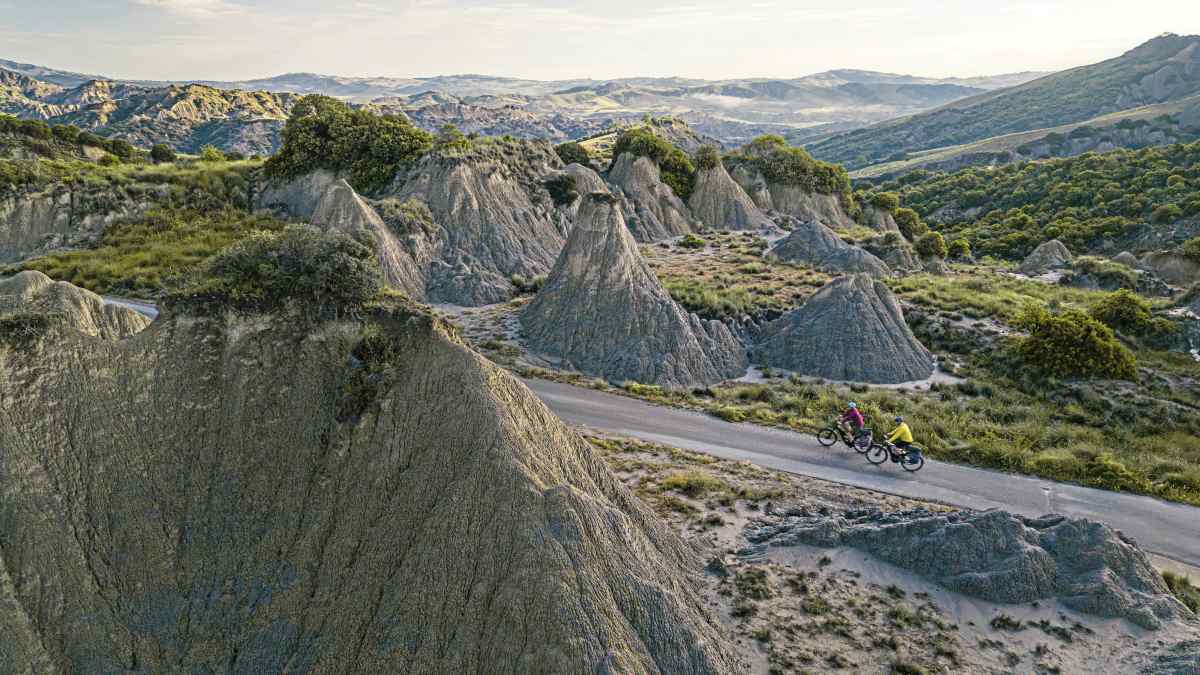
From Maniago, the route leads through a landscape full of contrasts: rolling hills, wild river valleys and the approaching peaks of the Carnic Pre-Alps. In Cavasso Nuovo, it is worth taking a culinary break: the famous red onion from Cavasso, DOP-protected and uniquely mildly sweet, characterises the regional cuisine. The route continues along the Meduna stream, whose crystal-clear water rushes through pristine gorges. The natural oases of Navarons and Paludana offer refreshment and relaxation on the two beaches - don't forget your towel! Toppo di Travesio is picturesquely perched on a rocky outcrop between the river meadows and Alpine peaks. Its ancient alleyways, flowering gardens and stone houses with courtyards dating back to the 18th century make it one of the "Most Beautiful Villages in Italy".
The cycle path continues through vineyards. The Bulfon winery is well worth a stop. With vision and passion, the family has dedicated itself to rescuing and cultivating forgotten and almost extinct indigenous grape varieties. At Pinzano al Tagliamento, the view opens up onto the mighty and spectacular Tagliamento, the last wild river in the Alps. The next highlight is at the Cornino Lake Nature Reserve: turquoise-green water shimmers between rock faces, above which griffon vultures circle - one of the few colonies of these majestic birds in Italy. The visitor centre provides information about the successful reintroduction project. After experiencing nature, stop off at Birra Garlatti Costa for a refreshing glass of craft beer. From there, it is only a few kilometres to the stage destination of Gemona del Friuli.
Traces of the Lombards: From Gemona del Friuli to Cividale del Friuli
The third stage leads past castles and through fine vineyards to the Lombard UNESCO World Heritage Site in Cividale del Friuli.
Gemona del Friuli, a picturesque medieval town at the foot of the Julian Alps, was impressively rebuilt after an earthquake in 1976. The Cathedral of Santa Maria Assunta greets cyclists with its imposing façade. Today, the city combines history with contemporary architecture and street art and forms the gateway to the UNESCO Julian Alps Biosphere Reserve. A few kilometres further on, the imposing Artegna Castle sits enthroned on a hill. The small medieval town at its foot delights with its winding alleyways and the magnificent Savorgnan Castle. From Savorgnano del Torre, the landscape becomes gentler and the hills softer.
They merge into the vineyards of the renowned DOC Friuli Colli Orientali wine region. These produce some of the best wines in Italy, such as the autochthonous Pignolo and Schioppettino - a stop at one of the traditional wineries is a must. Gubana, the spiral-shaped yeast dough pastry with a walnut and sultana filling that is part of every Friulian celebration, is also served here.
The final descent to Cividale del Friuli is spectacular: the town founded by Julius Caesar as the Forum Iulii - giving its name to the whole of Friuli - rises picturesquely above the Natisone river. From 568 AD, Cividale was the seat of the first Lombard duchy in Italy and later the residence of the Patriarchs of Aquileia. The Devil's Bridge, which boldly spans the gorge, is just one of many highlights: The Tempietto Langobardo, a UNESCO World Heritage Site with breathtaking stucco work, and the National Archaeological Museum document the extraordinary importance of this city.
Into the heart of the Collio wine-growing region: from Cividale del Friuli to Gorizia
World-class wines, Austrian heritage and the legendary Rose of Gorizia characterise the last section of the cycle route to the Slovenian border.
The route winds along the Natisone River through a landscape where vines play the leading role. In Manzano, the Acetaia Midolini, one of the largest vinegar factories in the world, invites you to visit. After San Giovanni al Natisone, Monte Quarin greets you, at the foot of which lies Cormons. The town breathes Austrian history: a statue of Maximilian I of Habsburg watches over Piazza Libertà, while the Cathedral of Sant'Adalberto impresses with its magnificent flight of steps. Here the route changes from the Friuli Colli Orientali DOC area to the legendary Collio wine-growing region. The hills, planted for centuries, produce world-class wines - Ribolla Gialla, Friulano and Malvasia.
The Trattoria al Cacciatore la Subida in Cormons is a culinary must: the Sirk family has been combining Slovenian and Friulian cuisine with the region's fine wines here for generations. The cycle route leads through the fine wine region of Russiz, where the Villa Russiz winery invites you to taste its wines, and on through the shady Preval forest to Gorizia. Surrounded by vineyards, the characteristic yellow "Collio's windows" invite you to take a break: striking panoramic benches set the scene for the gentle vineyard hills like living paintings. The border town, once known as the "Nice of Austria", impresses with its Habsburg charm, flowery gardens and beautiful places for an aperitivo: the Viatori azalea garden becomes a sea of flowers in spring, the Piuma Park with its exotic trees an oasis of peace. Gorizia's culinary delights include Gorizia goulash, plum dumplings and Presnitz cake. Particularly delicious: the winter radicchio "Rose of Gorizia" with its rosy shape, red colour and delicate bitter taste.
GPS data: Pedemontana cycle path
At this point, you will find external content that complements the article. You can display and hide it with a click.
The region: Friuli Venezia Giulia
Friuli Venezia Giulia is located in the north-east of Italy and is easily accessible from Germany. It offers a wide variety of unspoilt natural landscapes: In less than two hours by car, you can travel from the peaks of the Alps and Dolomites to the sandy beaches of the 130 km long Adriatic coast, across vast plains with majestic rivers such as the Tagliamento and Isonzo, to the gentle vineyards of the hilly landscapes. Everything is close together: in the morning you wake up in the mountains, at lunchtime you enjoy a meal by the sea and in the evening you dine among the vineyards.
Cultural influences characterise the region. Austro-Hungarian heritage meets Slavic-Balkan traditions, the Mediterranean way of life merges with Venetian flair, while the independent Friulian culture with its own language forms the unifying element. This diversity still characterises the architecture, cuisine, language and way of life today
Paradise for gourmets
The world-famous San Daniele ham, air-dried in the hills of San Daniele del Friuli, is considered one of the finest cured hams in the world. It is accompanied by excellent white wines: The DOC areas of Collio, Colli Orientali and Isonzo produce Ribolla Gialla, Friulano and Malvasia of international standing - wines that are among the best in Italy. Friulian cuisine with influences from Austria, Slovenia and Veneto creates a unique gastronomic identity - down-to-earth, honest and of the highest quality.
Cycle tourism
With five long-distance cycle routes and 100 circular routes, a dense network of cycle paths criss-crosses the region and opens up its extraordinary diversity: the spectrum ranges from the lagoons of the Adriatic to the gentle vineyards of the Collio and the spectacular Alpine valleys of the Carnic and Julian Alps. The Ciclovia Pedemontana FVG3, the Alpe Adria cycle path and the Ciclovia del Tagliamento are among the flagships of this infrastructure.
Bike & Rail/ Bike & Boat / Bike & Bus: The dense network of cycle paths is complemented by an extensive transport infrastructure of trains, buses and boats.
The comprehensive offer for leisure cyclists, gravel and mountain bikers in Friuli Venezia Giulia is available at www.turismofvg.it/de/bike
You can find even more bike adventures in Italy here: