


Experience three wonderful, green trail days and probably not meet another person along the way: Wales is located in western Great Britain, is about the size of Hesse, but has only half as many inhabitants - and they mainly live near the coast. It is therefore highly unlikely that you will meet other people on the Trans-Cambrian route. Spich: You spend three days travelling through the lonely, lush green of the Cambrian Mountains.
The mountains shake hands in Mid Wales and are connected by a trail network that only exists in the UK. The locals know their trade here: the lines are created with shovels, but they never lead directly from A to B. The trails play with the terrain. Instead, the trails play with the terrain. As long as it is conducive to riding fun. Rocks, roots and small drops are deliberately left as play elements and momentum boosters. Even if it's uphill.

And the Trans-Cambrian route has a lot of uphill sections. Although the mountains are a maximum of 750 metres high, the many ups and downs take even more energy. As does the possible headwind, which usually sweeps over from the Atlantic. Of course, you could also simply cycle the route in the opposite direction, but firstly, you would then cover significantly more metres in altitude and: The climbs are steeper in a west-east direction. That's why it's better to trust the locals when they say that the tour is most fun if you start in Knighton on the border with England and head west towards the coast of the Irish Sea.

The tour: Trans Cambrian Way
Total: 166.2 kilometres / 3183 vertical metres / 3355 vertical metres / 3 stages
The scenic highlights: Elan Valley Reservoirs, Claerwen Reservoir, Tarenig Forest, Llangurig and the Hafren Forest. At the end, you are not only on the coast of the Irish Sea, but also at the gates of Snowdonia National Park.

Stage 1: From Knighton to Rhayader
- Length: 54 kilometres
- Uphill: 1200 metres in altitude
Stage 2: From Rhayader to Llangurig
- Length: 74 kilometres
- Uphill: 1600 metres in altitude
Stage 3: From Llangurig to Machynlleth
- Length: 47 kilometres
- Uphill: 1200 metres in altitude
You can tackle the tour on your own or with the locals from mtb.wales as a guided tour. The guides have worked on the route and naturally know their way around. Especially when it comes to tackling perfectly tailored trails and staying in the most rustic bed & breakfast accommodation. Price incl. accommodation with half board, luggage transport and return transfer: £449 (approx. €515), dates and information: www.mtb.wales
The Eryri extension
From the finish of the Trans Cambrian route, you can see the very promising peaks of the Eryri or Snowdonia National Park. After the Trans Cambrian, you could go straight into the extension or tackle this somewhat more challenging 4-day tour from Machynlleth to Conwy on the north coast of Wales. Here, however, you can expect significantly longer ascents and descents, rockier terrain, but also a landscape that is even more suitable for canvas. The "Eryri Route" has a total of 225 kilometres and costs 895 pounds (approx. 1025 euros) per participant. Half board, luggage transport and return transfer are also included in the price. Info: www.mtb.wales

7 things you should know on a trip to Wales
1. Wales is trail centre country
You could almost say that there is no village without a decent and signposted trail circuit. So an additional road trip is definitely worthwhile here. The Big 5, which should definitely not be left out of this huge offer:
- Coed y Brenin
- Afan
- BikePark Wales bikeparkwales.com
- Cwmcarn
- Antur Stiniog
All trail centres in Wales at a glance: mbwales.com
2. entry conditions 2026
Since the UK left the EU, you need a passport that is valid for at least 3 months to enter the country. An identity card is not sufficient! In addition an electronic travel authorisation from 25 February 2026ETA (Electronic Travel Authorisation) is required. And you can only get this here: GOV.UK
3. money exchange
The fact that you have to change money for the UK has never been different, because the British were never in the currency union. One GBP (Great Britain Pound) is currently worth 1.14 euros. The best way to get money is to withdraw it directly from a local ATM. There are ATMs practically everywhere. Tip: It is best to withdraw a large amount once to minimise the bank charges incurred.
4. the right clothes
Yes, you have to bring your rain gear. Wales is on the west coast and is often covered in short showers from the Atlantic. But there are also days when even the locals run from one shelter to the next because it's pouring with rain. In this case, my colleague from the accessories department has come up with a really useful Packing list for Wales put together. Because on the often treeless mountain slopes, the shelter options are not particularly good.
5. bug spray and brake pads
The mosquito spray from the medicine cabinet can safely stay at home. Not because there are no midges in Wales - quite the opposite. It's just that the Welsh pests are of a completely different nature and robustness to the ones we can still ward off to some extent with Autan and the like in our part of the world. In Wales, the so-called midges lurk alongside the normal mosquitoes. They are tiny, sit in the grass and wait for calm and dusk. If you don't have a local repellent spray specially designed for this species, you will probably be very, very annoyed.
Don't forget spare pads for the brakes, because when it rains and the trails are soaked, the dirt is particularly abrasive on the stoppers.
6. parking fees must be paid!
If you are travelling by hire car (watch out for left-hand traffic!!) and are planning a road trip from one trail centre to the next: please don't forget to pay the parking fees. The average charge is £6 per day per vehicle. This money goes straight into the trail builders' coffers and when you see how much work and passion goes into maintaining these trails, it's not a cent too much.
E-bikers sometimes have to pay a little more. Up to 15 pounds.
7. bed & breakfast
Even if you're travelling by campervan, you should treat yourself to a bed & breakfast every now and then. Firstly, it's fun to socialise with the locals and secondly, you get to enjoy a full Welsh breakfast: fried seaweed with cockles, bacon, sausages, mushrooms, eggs and often smoked fish (don't worry: Scottish haggis is not included). For a good place where hospitality is lovingly celebrated, you should expect to pay around 50 - 70 euros. It's best to simply google B & B on the spot. You can also find a rough overview here: visitwales.com
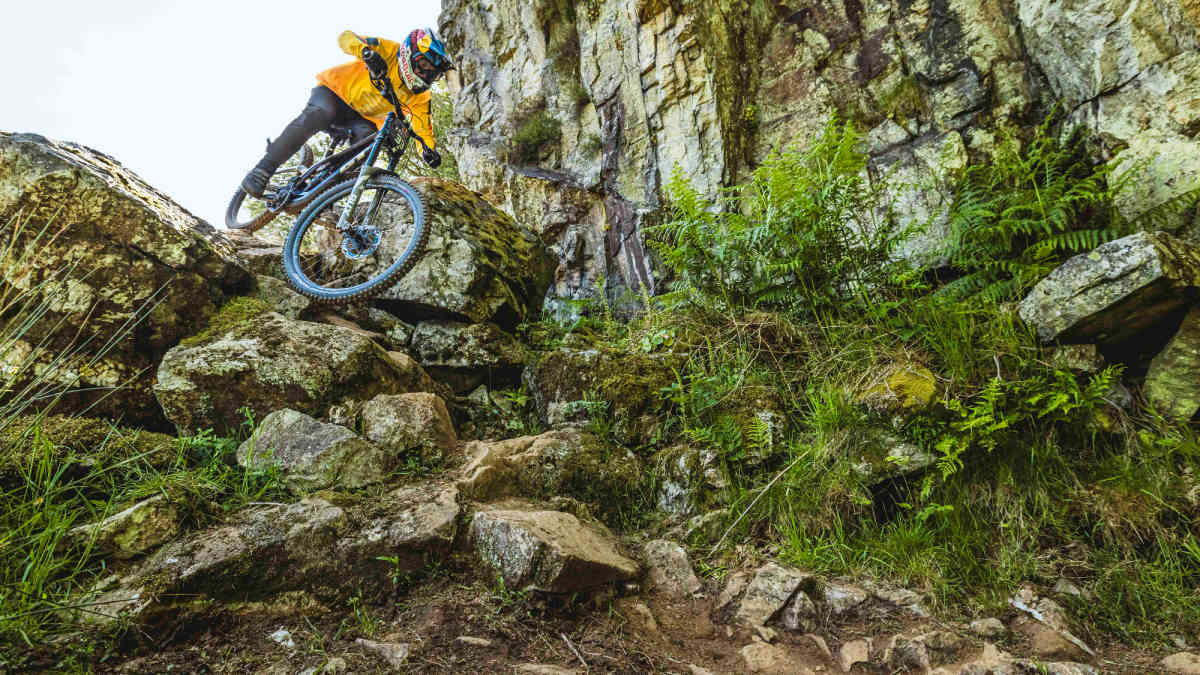
For professionals only: Hardline Wales:

Gitta Beimfohr
Editor
